
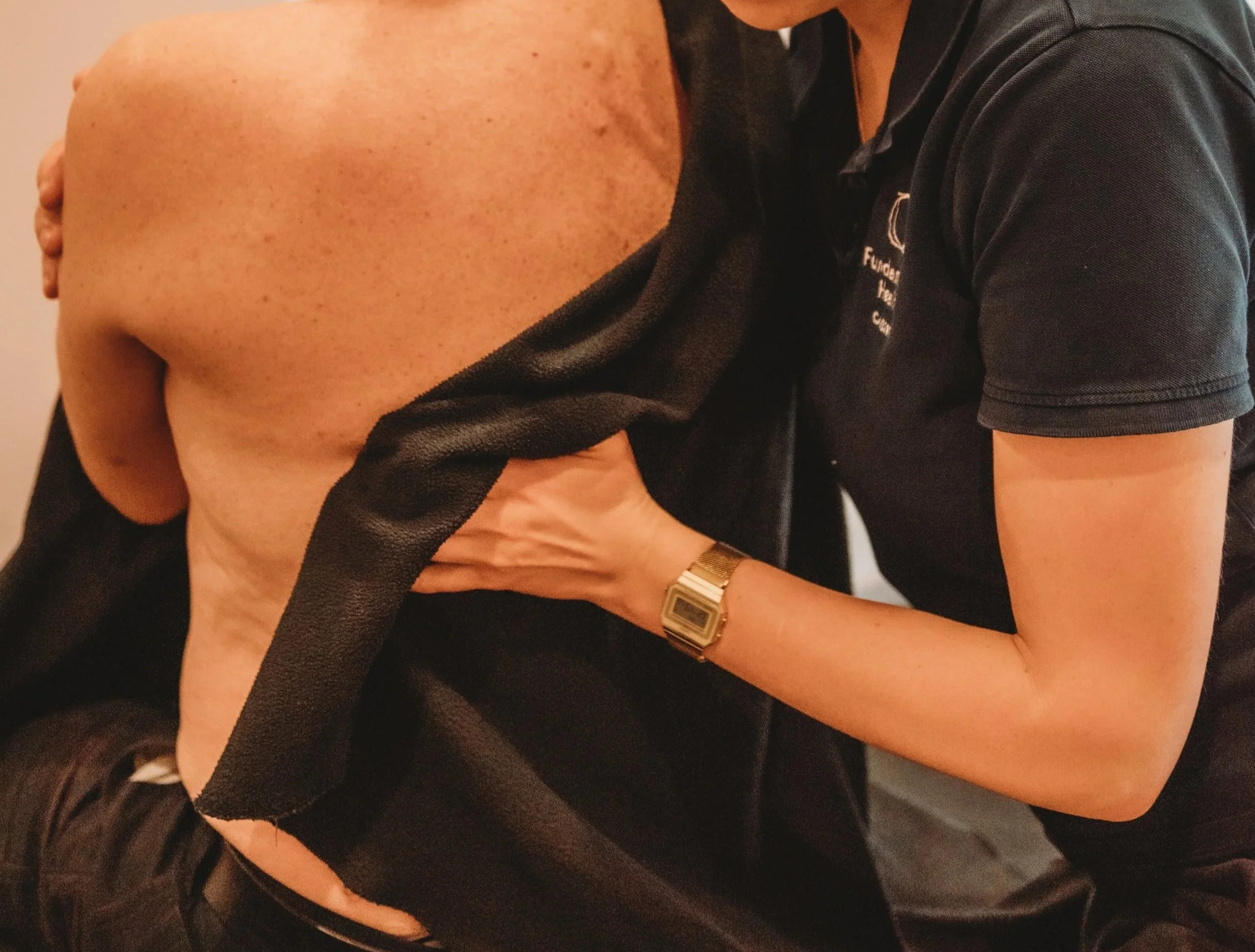
Alyssa, an Osteopath, discusses posture.
For many people, the advice around posture is familiar: sit up straight, shoulders back, don't slouch. Well-intentioned, but the evidence behind it is less solid than commonly assumed.
Research has largely failed to establish a consistent link between any specific sitting posture and low back pain. Ergonomic optimisation alone has shown inconsistent results, with current evidence rated as moderate to low quality. The premise that there is one correct position, and that deviating from it causes injury, does not hold up under scrutiny.
The body is not designed to be still
Osteopathy understands the body as a dynamic, integrated whole, where structure and function are inseparable. How we move shapes how we feel, and how we feel shapes how we move. It is why a static model of "correct" posture misses something fundamental.
The issue is not which position a person adopts, but how long they remain in it. Sustained stillness leads to progressive muscle fatigue and a gradual build-up of stress in surrounding tissues. The body is inherently self-regulating; given the right conditions, it adapts and recovers. What it struggles with is not movement, but the absence of it.
Your best posture is your next posture.
What the evidence supports
A 2022 systematic review in Cogent Engineering (Radwan et al.) found that breaks of one to two minutes significantly reduced neck, shoulder, and lower back discomfort in desk workers, independent of how they were sitting. Standing desks show similar limited benefit unless genuinely paired with regular movement.
Variability matters more than optimisation. What the body needs is change, regularly and throughout the day.
In practice, this looks like:
A short break every 30 to 45 minutes: even just standing up, stretching, or walking to get a glass of water. Setting a phone timer makes this surprisingly easy to stick to.
Mixing positions throughout the day: sitting, standing, perching, moving. No single position is the goal.
Short walks to interrupt long stretches of sitting: even a few minutes around the office or block can help.
Moving in different directions: rolling your shoulders, turning your head, gently arching and rounding your back, rather than trying to hold any "correct" shape.
When self-management isn't enough
Pain that lingers, recurs, or begins to affect sleep and concentration is a signal that the whole picture needs attention, not just the posture.
Research in pain neuroscience shows that beliefs about posture and movement can themselves drive pain and avoidance. A person told their spine is "damaged", or posture is "wrong", may begin to move with fear, compounding the problem. Understanding that pain is not always a reliable signal of tissue damage, and that movement is safe, supports better recovery.
Osteopathic care takes a different approach. Rather than prescribing a correct position or treating the body as parts to be fixed, assessment considers the whole person: movement patterns, pain experience, and the factors maintaining symptoms. Treatment is then built around that individual, drawing on the body's own capacity to recover and adapt.
The goal is not a perfect posture. It is a body that moves well, recovers well, and keeps up with the demands of your day.
To make an appointment
References
Swain CTV, Pan F, Owen PJ, Schmidt H, Belavy DL. No consensus on causality of spine postures or physical exposure and low back pain: a systematic review of systematic reviews. J Biomech. 2020;102:109442. doi:10.1016/j.jbiomech.2019.08.006
Radwan A, Barnes L, DeResh R, Englund C, Gribanoff S. Effects of active microbreaks on the physical and mental well-being of office workers: a systematic review. Cogent Eng. 2022;9(1):2026206. doi:10.1080/23311916.2022.2026206
Butler DS, Moseley GL. Explain Pain. 2nd ed. Adelaide: Noigroup Publications; 2013.
Medina-Viedma L, Cortés-Pérez I, Obrero-Gaitán E, Osuna-Pérez MC, Díaz-Fernández Á, López-Ruiz MDC, et al. Effectiveness of pain neuroscience education in reducing pain, disability, kinesiophobia, and catastrophizing in patients with chronic low back pain: a systematic review and meta-analysis. Med Sci. 2025;13(4):290. doi:10.3390/medsci13040290